Author: Miroslav Kukrál
Year: 2015 -
Illustrations: Jiří Svoboda
Design of a concept for bringing to life the world-unique palaeobotanical site of Ovčín near Rakovník through an application for mobile platforms and web browsers.
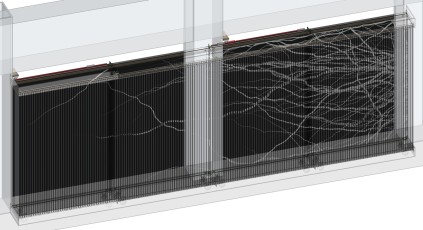
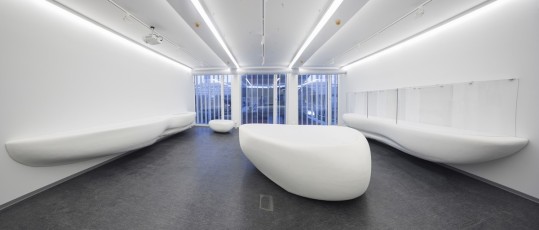
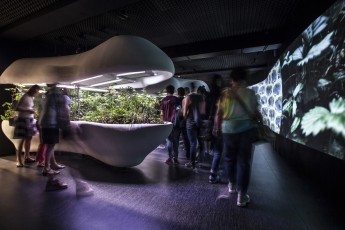
The aim of the project is to reconstruct the Carboniferous primeval forest in the engaging form of augmented, or extended, reality. It will show us the appearance and development of the forest of that time in exhibitions for the public, as an application generating a Carboniferous forest live in the viewfinder of a mobile phone, or as a map in a web browser.
Until now, the results have for years been presented through the drawings and paintings of Jiří Svoboda. For visualisation, however, it is very problematic when new discoveries in the field overturn existing knowledge; these artworks can then suffer from factual inaccuracies. A tool capable of displaying entire biotopes and the relationships between individual plants over time, adapted to any terrain, could then attract public attention and support research of the world significance that the site rightly deserves.
A separate chapter here is depicting the true scale of the giant plants of the local Carboniferous. The film Journey to the Beginning of Time was surely so successful partly thanks to its skill in showing people at the scale of that environment.


I include an interview on Czech Radio with Stanislav Opluštil, one of the research leaders, which explains the significance of the site:
The buried forest
One of the most important palaeontological sites in this country is Ovčín near Radnice in the Rokycany region. Underground lie very well-preserved remains of a primeval forest from the Upper Carboniferous - it was buried by volcanic ash more than 300 million years ago. Research by Czech palaeontologists has made Ovčín famous all over the world.
full interview at rozhlas.cz/planetarium/priroda/
The Ovčín palaeontological site lies around the former opencast hard coal mine of the same name, which is now flooded. The artificial lake lies about a kilometre south of Radnice. We spoke about the site with palaeobotanist Stanislav Opluštil of the Institute of Geology and Palaeontology, Faculty of Science, Charles University in Prague.


We have already partly hinted at what makes this site exceptional - its form was shaped by prehistoric volcanic activity. What more could we add?
Stanislav Opluštil: What makes this site and others like it exceptional is that the roughly 310-million-year-old Carboniferous vegetation is buried here where it grew; it was covered by volcanic ash, and the plants are found in the places where they originally grew. In sedimentary rocks, which are often part of coal basins and contain plant fossils, something like this is not at all common - there we are dealing with plant remains that were carried away by water over greater or shorter distances, so information about the structure of the plant community was lost.
So what have been the most important discoveries of the research at Ovčín?
Stanislav Opluštil: The research at Ovčín has provided information on the composition of a tropical wetland forest from the Upper Carboniferous, roughly 300 - 310 million years ago, which significantly adds to our previous knowledge of this vegetation, above all in terms of its structure. Species living in particular relationships with one another were described; the herb, shrub and tree layers were identified, as well as some elements that rose high above the canopy of the forest. It was also possible to determine the way of life of some plants, for example whether they were lianas or small understorey plants, and so on. Way of life, structure, composition of the stand and the density of spacing between plants. This is information that is not normally found, and that is exactly what makes the record from the Ovčín site unique.
Research at the site has been carried out fairly intensively for a number of seasons. It is organised by the West Bohemian Museum in Pilsen in cooperation with the Czech Academy of Sciences, the Faculty of Science of Charles University, the Czech Geological Survey and the National Museum in Prague. This summer, too, brought a number of interesting finds. The daily press, for example, reported the discovery of a fossil Carboniferous spider at the very Ovčín site.
Stanislav Opluštil: That's true, the spider is probably the best known, because so few of them are found... A Chinese colleague who took part in the excavations found a Carboniferous spider about two centimetres long, which was part of the life of the tropical forest of that time, on the first or second day of the research, I believe. From the previous excavation in 2006 we have another unique find, and that is a Carboniferous dragonfly. This specimen's wingspan was around 50 - 55 centimetres, so according to our current knowledge it is, I believe, the second largest known dragonfly in the world. The largest is the so-called Meganeura from France, which had a wingspan of around 75 centimetres, so we were essentially still some 20 centimetres short of the record. Maybe next time.
There haven't been many finds from the animal kingdom at the Ovčín site...
Stanislav Opluštil: In the six excavations we have carried out there since 2002, we have found only two more distinct remains - precisely the dragonfly and the spider mentioned. Otherwise only small pieces were found, fragments that are hard to identify. Those were not widely published.
Another thing that has been written about is epiphytic plants, with the claim that their discovery offers a completely new view of what the Carboniferous forest looked like.
Stanislav Opluštil: Finding proof that a plant was an epiphyte growing on other plants, often in the crowns of trees, much like today's mistletoe and many other plants, is not at all easy for a period 300 million years ago. Our results indicate that some plants really could have been such epiphytes. The evidence lies mainly in the fact that they were found, for example, in association, that is together, with the branches of arborescent lycopsids, or in the upper parts of the trunks of these lycopsids in the upper part of the volcanic ash. Remains of these potentially epiphytic plants practically never occurred in the lower part, at the base of the tuff, where we would expect them if they were plants growing only in the understorey. We would of course like to find some direct proof, but even this exceptional site has not yet yielded anything of the kind. Nevertheless, the very way in which some species occur suggests that they most probably led an epiphytic way of life.
You also mentioned the density of the Carboniferous forest. What were the ideas in the past, and what can be said about it today?
Stanislav Opluštil: Older reconstructions tend to show forest stands or vegetation of varying density. In this respect we have reached similar results, only they are backed by concrete data from our own research. We found that in some places the forest was fairly dense - the trunks, mainly of arborescent lycopsids but also of other plants, or more precisely what remained of them, are found about two metres apart, often even less. However, in some places, over an area of perhaps 30 - 50 square metres, not a single tree was standing at the time the volcano buried the forest. There was a small glade where only herbaceous plants grew, small horsetails, ferns and some seed ferns.
This year's research at Ovčín was also attended by scientists from the Chinese Academy of Sciences, and German scientists were originally due to come as well, but in the end they did not appear at the site.
Concluding remarks by palaeobotanist Stanislav Opluštil of the Institute of Geology and Palaeontology, Faculty of Science, Charles University in Prague.